Original-unit part sourcing difficulty
What we can tell you: on a first visit we check the obvious failure points - capacitor, logic board, drive gear, safety sensors, wall switch wiring - before we quote anything.
Livermore, CA
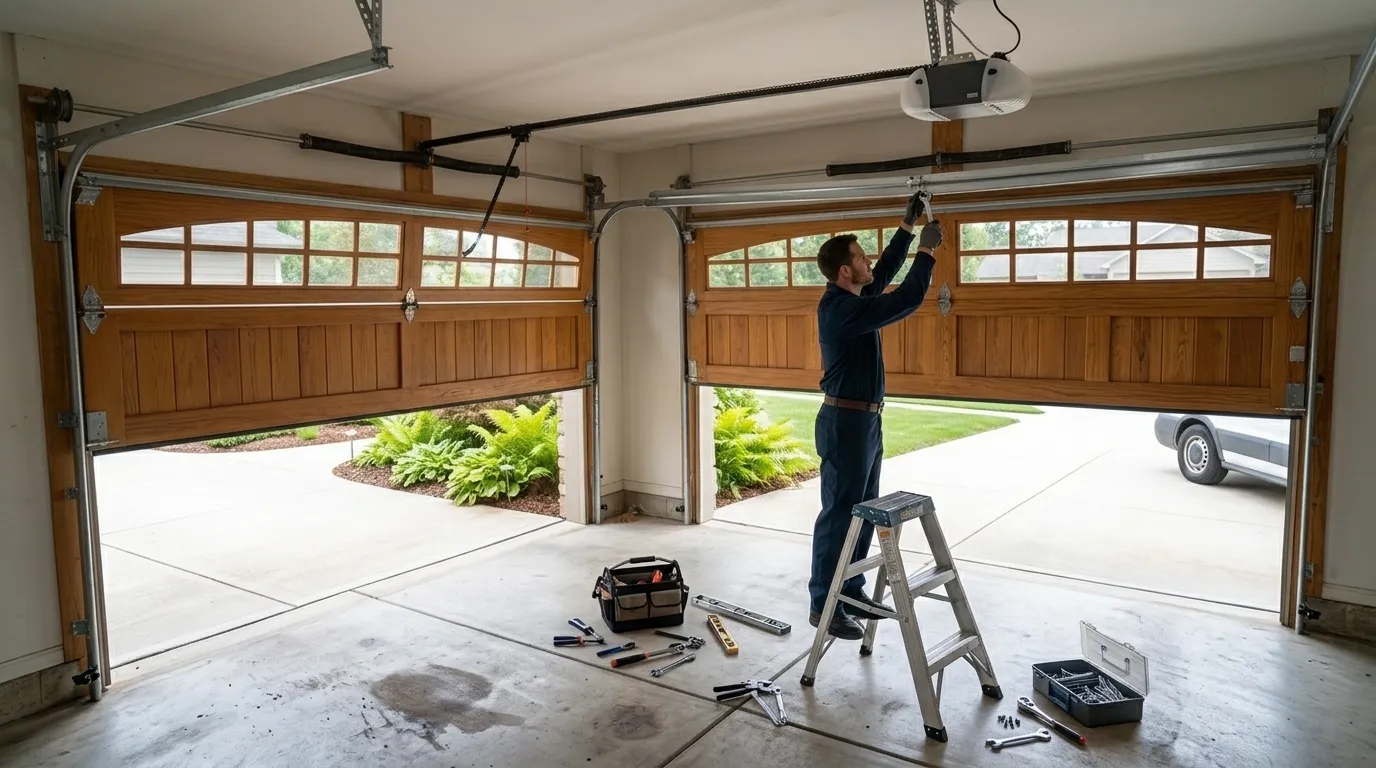
Opener repair for Livermore homes built mostly between 1961 and 2010. We diagnose dead openers, failed logic boards, and worn gears before you pay for a new unit.
Pricing
We don't post a flat number for opener repair because the fix depends on what's actually broken. A stripped gear on a chain-drive unit is a different job than a fried logic board, and a burned-out circuit board on an opener from the 1980s often costs more to source than the opener is worth.
What we can tell you: on a first visit we check the obvious failure points - capacitor, logic board, drive gear, safety sensors, wall switch wiring - before we quote anything.
If your opener is original to a house built in the early part of the 1961-2010 window that covers most of this service area, replacement parts get harder to find, and that shifts the math toward a new opener rather than a repair.
We'll say so plainly instead of stretching a repair past the point it makes sense. No price gets quoted over the phone with any real accuracy, because we haven't seen the unit yet.
Watch-outs
The most common mistake we see is a homeowner replacing the opener before checking the door itself. If the springs are tired or a track is bent, a brand-new opener will strain against that resistance and burn out again in months. Another one: swapping the logic board on an opener manufactured before the mid-1990s, when the part is discontinued and the board that arrives is a generic aftermarket substitute that doesn't match the wiring harness. We've also seen remote-and-sensor troubleshooting turn into a wasted service call because the real fault was a loose wire nut at the wall switch, not the opener at all. A repair that only addresses the opener and ignores the door hardware behind it is a repair that comes back.
Local causes
Across this service area, housing stock runs from 1961 through 2010, with a median build year of 1981, and the bulk of it - spanning 19 named communities - dates to the 1980s and '90s.
That means a huge share of openers in service right now are original chain-drive or early belt-drive units from that same window, running on capacitors and logic boards that were never designed to last five decades.
Add the mild temperate climate common to this area: no deep freeze to crack housings, no extreme humidity to corrode boards fast, but plenty of dust and temperature swings inside an uninsulated garage that slowly degrade capacitors and gear teeth anyway. It's not dramatic weather damage - it's just age catching up with parts nobody's replaced since the house was built.
Warning signs
A door that won't respond to the remote but works from the wall button usually points to a dead remote battery or a receiver antenna issue, not a motor problem. A door that reverses partway up or down, or refuses to close at all, is almost always the safety sensors - either misaligned, dirty, or wired loose. Grinding or clicking with no movement means the drive gear has stripped, common on chain-drive units that have logged a couple of decades of daily use. If the opener runs but the door barely moves, or the motor hums without lifting the door, that's often the door's springs doing none of the work they used to, not the opener failing on its own. A opener that trips the breaker repeatedly needs an electrician's eyes before ours.
Questions
Disconnect the opener using the manual release cord and try lifting the door by hand. If it's heavy, uneven, or won't stay up on its own, the springs or hardware are the problem, not the opener. If it lifts smoothly and evenly, the opener is the likely fault.
Sometimes. It depends on whether the failed part - capacitor, board, gear - is still available. Given how much of this service area's housing dates to that decade, we run into this often, and we'll tell you honestly when replacement is the cheaper, more reliable path.
We diagnose most residential chain, belt, and screw-drive openers regardless of brand. What limits a repair isn't the brand, it's whether the specific failed part is still manufactured or sourced as a compatible replacement.
Intermittent failure usually traces to a loose wire connection, a weakening capacitor, or sensor alignment that shifts slightly with temperature. It rarely means the whole unit is failing all at once - but it's worth having checked before it stops working entirely.
Explore more
Ready when you are
Livermore Garage Door Pros repairs and installs garage doors, springs and openers in Livermore, CA and the surrounding area.